
CITT News
NSF Data Privacy Study Lands on Long Beach Streets
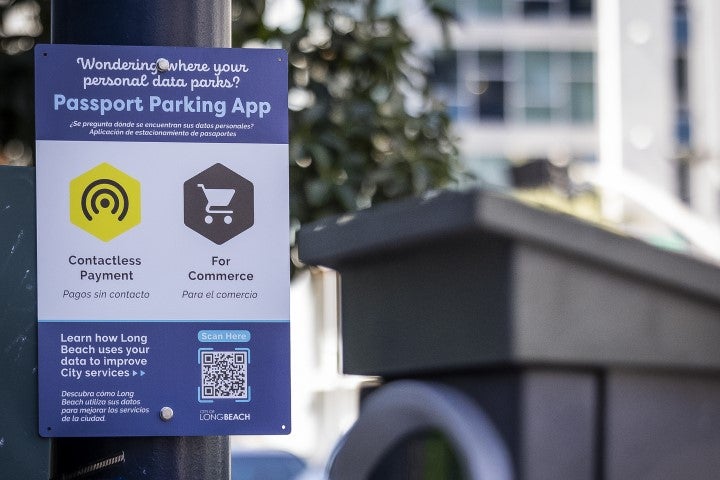
PHOTO: These street signs were designed by CSULB Graphic Design student Kiana Nguyen.
This spring, keep your eyes peeled for bright blue signage adorning various civic technologies such as parking payment kiosks, license plate scanners, security cameras and bike share docking stations in three Long Beach neighborhoods (Downtown, Cambodia Town and North Long Beach). Each sign features a QR code that serves as a gateway, directing residents to a digital dashboard containing detailed information about the purpose and function of each technology, how long it is stored, and whether it is shared. The signage and related “Digital Rights Platform” help Long Beach residents gain an understanding of how the City of Long Beach utilizes specific technologies and the resulting impacts.
The project, entitled “Trust, Transparency and Technology: Building Digital Equity Through a Civic Digital Commons,” is funded by a planning grant from the National Science Foundation’s Smart and Connected Communities program. CSULB Journalism Professor Gwen Shaffer, Ph.D., serves as Principal Investigator (PI) along with CITT Interim Executive Director Tyler Reeb, Ph.D., and City of Long Beach Technology Partnerships Officer Ryan Kurtzman who both serve as Co-PIs for the project.
Shaffer, with support from CITT and the City of Long Beach’s Technology & Innovation Department, recently led “data walks” with nearly 80 Long Beach residents to test the efficacy of the Digital Rights Platform. During the data walks, researchers asked residents about their comfort levels and attitudes toward the City’s data collection practices, and about their experiences interacting with the platform.

PHOTO: Dr. Gwen Shaffer discussing the Data Walks at Long Beach City Hall.
“Our goal is to increase trust with the City by being transparent with our data collection, management and usage,” said Data Privacy Analyst Omar Moncayo. “I encourage residents to participate in these data walks, communicate their overall sentiment of each technology, and learn about the information collected when you interact with City technologies.”
By bringing in the community at the start, Data Walks and QR code equipped signage will allow the City to implement smart technologies in an inclusive, democratic, and ethical manner. The research team has plans to expand the Long Beach Digital Rights Platform, with the goals of:
- Examining data privacy rights and expectations across competing needs of local government, third-party vendors and residents, and the City’s Data Privacy Guidelines.
- Examine how traditional power structures (i.e., city government, technology platform vendors) mobilize smart city technologies and the corresponding impact on human decision-making.
- Examine how trust is constructed; study how strongly residents value/weigh factors such as transparency, accountability, agency, integrity, accuracy, and fairness when interacting with smart technologies.
The project team is pleased to announce that they will be included in the City of Long Beach’s Civic User Research cohort for 2024.
More CITT in the News More Education and Training More Trade & Transportation