
CPaCE News
CSULB Grad Christopher Clark Named Santa Cruz County Sheriff
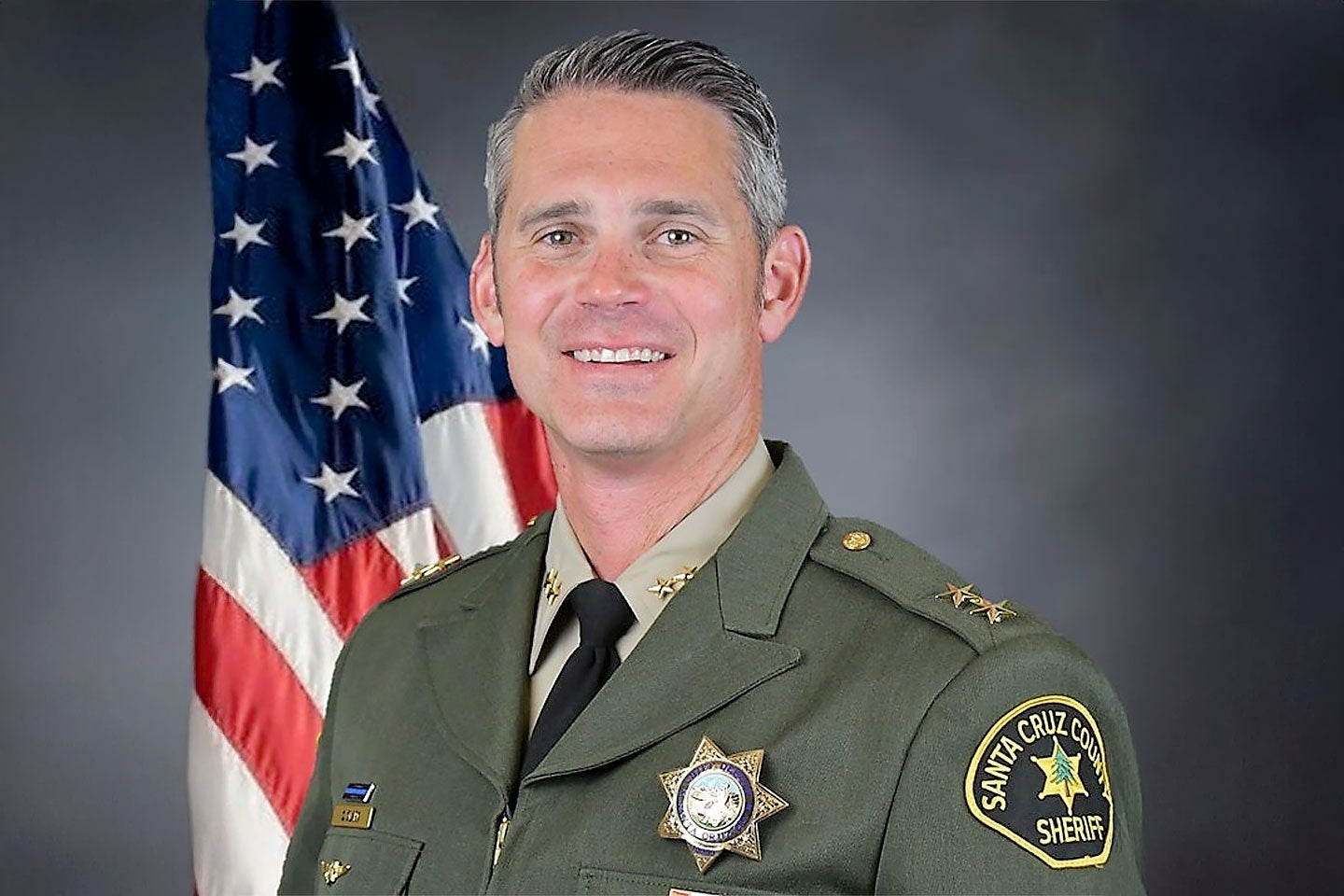
Christopher Clark, a graduate of the Master of Science in Emergency Services Administration (EMER) degree program at CSULB, has been appointed Sheriff of Santa Cruz County. Known for his progressive approach to policing, Clark officially took on this leadership role in December 2024. He credits online classes and the guidance of EMER program director, Dr. Shirley Feldmann-Jensen, for helping him earn his degree amidst a demanding workload as a detective and proud father of three boys. Clark’s experience in higher education has helped his department respond to challenges ranging from extreme weather events to police reform.
“That's where this master's program comes into play: when these promotion opportunities come up, hopefully you're in a really good position to be competitive in that process,” Clark said. “In the era of climate change, and an increased cycle of natural disaster emergencies, the EMER program provides a great asset in managing these crises.”
While working as a police detective, he learned about the EMER program from a family member who had graduated from the program and then became an assistant fire chief in San Francisco. Once he discovered that classes were 100% online, it was a no-brainer.
“When I looked at the program, I thought this is perfect for me,” he said.
Attending classes off and on between 2011 and 2015, Clark found it challenging to balance school and work, especially since crimefighting isn’t a nine-to-five job. Reshuffling his priorities, he temporarily dropped a few classes, but was rewarded professionally with a promotion to sergeant, enabling him to develop new policies and procedures in his department. His last hurdle for EMER was the capstone project, and he was considering taking a semester off to recalibrate, but a meeting with the program director gave him the encouragement he needed.
“Dr. Feldmann-Jensen said, ‘we're going to get you through this, whatever we need to do to get you help, but you need to graduate,’” Clark explained. “She gave a huge push for me.”
Clark’s capstone project earned an award for that academic year and made a positive contribution to the Santa Cruz County Sheriff's Office. After crunching budget numbers and securing grant funding, Clark bought and upgraded a Cessna 172 airplane for search and rescue operations and crime surveillance, providing a cost-effective tool to enhance his department’s abilities—and getting closer to graduation in the process.
“Something like that really integrates your academic experience in the EMER program with your job at the same time,” he said. “It seemed like a pretty seamless way to do both those things.”
Having spent his high school years in New Orleans, Clark was profoundly affected by Hurricane Katrina and the failures of mismanagement that occurred in response. In EMER classes that built leadership skills, he used the 2005 storm and its aftermath as a case study, examining what had gone wrong to avoid repeating the same mistakes.
“Here in Santa Cruz, with climate change, the magnitude of the disasters that we've seen in the last four years has been unprecedented for the county,” he said, naming floods in 2022 and the 2020 Santa Clara Unit Lightning Complex wildfires that burned a third of the county and destroyed thousands of homes.
“Looking at this from an emergency management standpoint, these disasters happen at a greater clip than they have,” he continued. “Having the knowledge, being able to speak the language, and understanding the concepts is important for a manager.”
Another contemporary issue that Clark is passionate about is police reform, with dedicated efforts to improve relationships between law enforcement and the communities they serve. The Santa Cruz County Sheriff's Office was one of the first departments to adopt the recommendations of President Obama's Task Force on 21st Century Policing, which followed protests against the 2014 killing of Michael Brown in Ferguson, Missouri. De-escalation training and communication assessment have since become a critical focus of Clark’s department.
“We changed our whole policing philosophy around the recommendations of that task force,” Clark explained. “I work for one of the most progressive agencies in the country. We've been ahead on almost every reform measure within law enforcement.”
“It's based on the sanctity of life,” he continued. “How do we deal with the public in a way that makes it safer for everybody involved? You have to accept the fact that policing has had a painful history, and policing means things to different communities across the country.”
“We just try to do the best job we can and hopefully people feel that there's legitimacy and credibility in what we're doing,” he said. “We have a great family-oriented office. We've got great training and invest heavily in our people.”
Investing in his fellow officers, their communities, and his own family remain top priorities for the sheriff. This sense of care made his graduation from the EMER program a special experience. While he was initially hesitant about travelling to campus, having attended the program entirely online, his wife urged him to reconsider and go to the commencement ceremony.
“I'd never been to Long Beach up to that point, but it was beautiful,” he said. “It was important for our boys to see that education matters and that they'll remember this.”
Learn more about the EMER program at California State University, Long Beach.
More Alumni Profiles More Community Outreach More Student Profiles