CPaCE News
Engineering Alum Flies High with NASA and Air Force
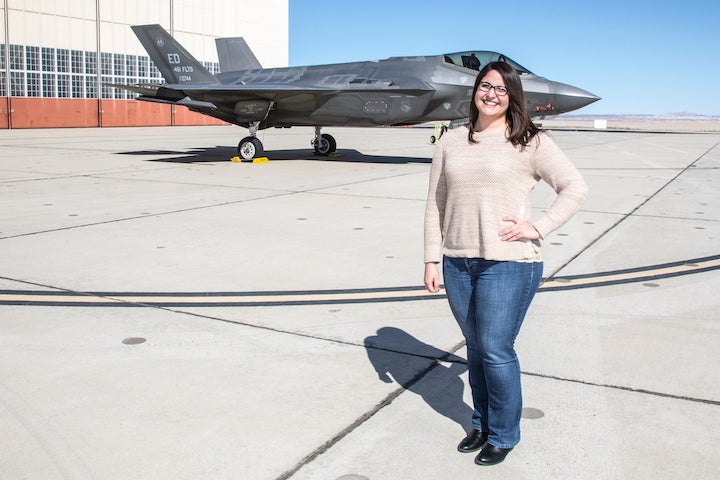
During her time in CSULB's Antelope Valley Engineering Program (AVEP), Marcea Ascencio didn't think the work she was doing was particularly extraordinary. But looking back on it now, she understands that the collaborative experiences she had with her Electrical Engineering cohort provided the perfect preparation for what she does now as a professional engineer.
As they moved through the program, the cohort grew very close. It was a great lesson for them to prepare for working in the industry, where typically multiple engineers work together on a project.
One of Marcea's best experiences in the program was her cohort's capstone design project. They were able to work on a project at the NASA Armstrong Flight Research Facility in Palmdale, California. This involved the implementation of a visual navigation system on a quadcopter vehicle. The division of work played on all of the students' unique strengths.
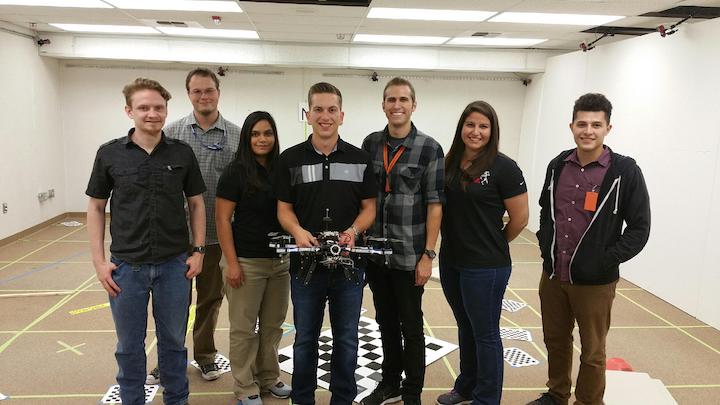
Photo caption: Marcea and the EE cohort at NASA Armstrong performing an indoor test of the navigation system they put on a quadcopter.
The ability to hold an internship as a student allowed Marcea to get a headstart on her engineering career. Paired with the excellent education that she received at CSULB AVEP, she was ready to hit the ground running as a full-time engineer when she graduated in December of 2016. She even had the opportunity to speak on behalf of the cohort at their graduation, which she thought was a great privilege.
Marcea took on a full-time position as a Guidance, Navigation, and Identification test engineer at Edwards Air Force Base (AFB). She has worked on the F-16 and F-35 fighter jet platforms. Currently, she is in a work-sponsored program that has allowed her to pursue her masters degree in electrical engineering full-time at Naval Postgraduate School in Monterey, California. Upon graduation in March 2021, she will return to Edwards AFB to work on the F-22 fighter aircraft.
When asked what she thought set AVEP apart from other programs, Marcea summed up three things that she thought produced great results. A lot of the professors were either full-time engineers in the local industry, or had industry experience that provided great networking and mentorship opportunities for students. The classes were always grouped together to allow for "off-days" where students could participate in local engineering internships. Finally, the set courses ensured that the engineering discipline was taught in broad strokes, allowing for a well-rounded education.
"This program is postured to produce very technical engineers for the local engineering industry," Marcea said. "Most graduates from this program were offered a full-time engineering job directly upon graduation!"
More Alumni Profiles